
Written by:
 Guest Author
 Sophia de Sousa
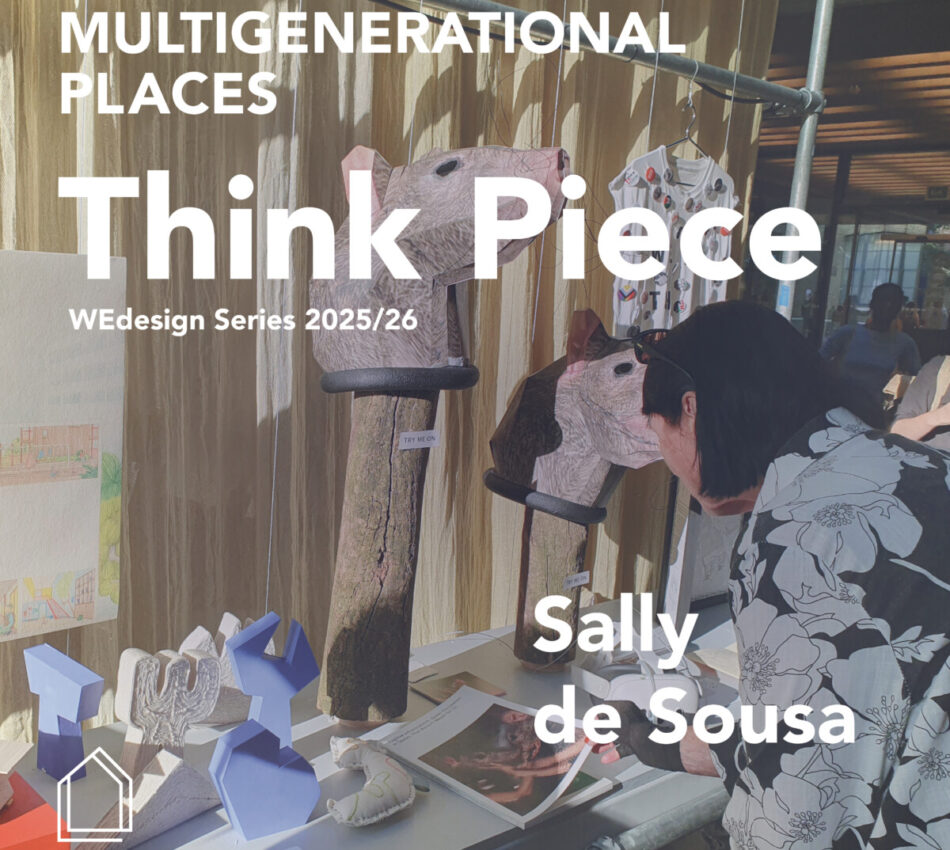
This piece captures excerpts of a conversation between The Glass-House Chief Executive Sophia de Sousa and her mother, retired theatre producer Sally de Sousa, on the theme of multigenerational places. Together they explore living in the new, and still evolving N1C Kings Cross development as an older person.
Reflecting on Living in Multigenerational Kings Cross
Sophia: When you first moved to Kings Cross a couple of years ago, you commented on the mix of ages you encountered when walking about. What struck you the most?
Sally: There’s a strong presence of young people here. When I take the dog out for a walk in the morning, I meet families taking their children to school. There is a primary school with nursery provision as well as a school for deaf children. And of course, there is Central Saint Martin’s, the university. So we have a range of stages in education within a very small area. Over the school holidays, there were also a lot of young people working at the tech companies on site, presumably on internships and apprenticeships.

I know that the mix of housing was very intentional in the design here. In the initial brief, that mix set out to include people of different ages and backgrounds. Older people were designed in through this building that I’m living in, where I have a wonderful home and am still able to lead an independent life with some support. Student housing brings in young people. The social housing on site means that there are lots of families living here. There are other residential buildings that attract different types of people.
Sophia: And of course, there are lots of people working here as well.
Sally: Yes, and one of the things that I found interesting reading about the original brief for Kings Cross was that they deliberately planned to bring in a working wealthy core, for example bringing the big tech companies in, not just relying on a residential wealthy core. But the people working on site I connect with most regularly when walking my dog are the other dog walkers, gardeners, the concierges of the residential buildings, the Kings Cross security and cleaning staff, people working at the restaurants and setting up tables outside. And there are also people constantly moving through the area, including travellers with their case heading to the three major stations.
Sophia: A lot of people don’t know that there is social housing here, but there is a strong presence of it here in the mix.
Sally: Yes, there is and that has brought families. The larger public spaces have been here from the start and are always packed with children and families playing in the fountains. They are still creating new, smaller play spaces for children and young people as new buildings open and more families move in.
There are so many places where I can go and sit and watch the world go by. It’s also a great pleasure for me to talk to people and to watch children playing. The children come over to me and want to talk to Billy [the dog] and stroke him. Then we often have a little chat. There’s a big community of dog owners who I see and speak to regularly when I’m out walking mine.
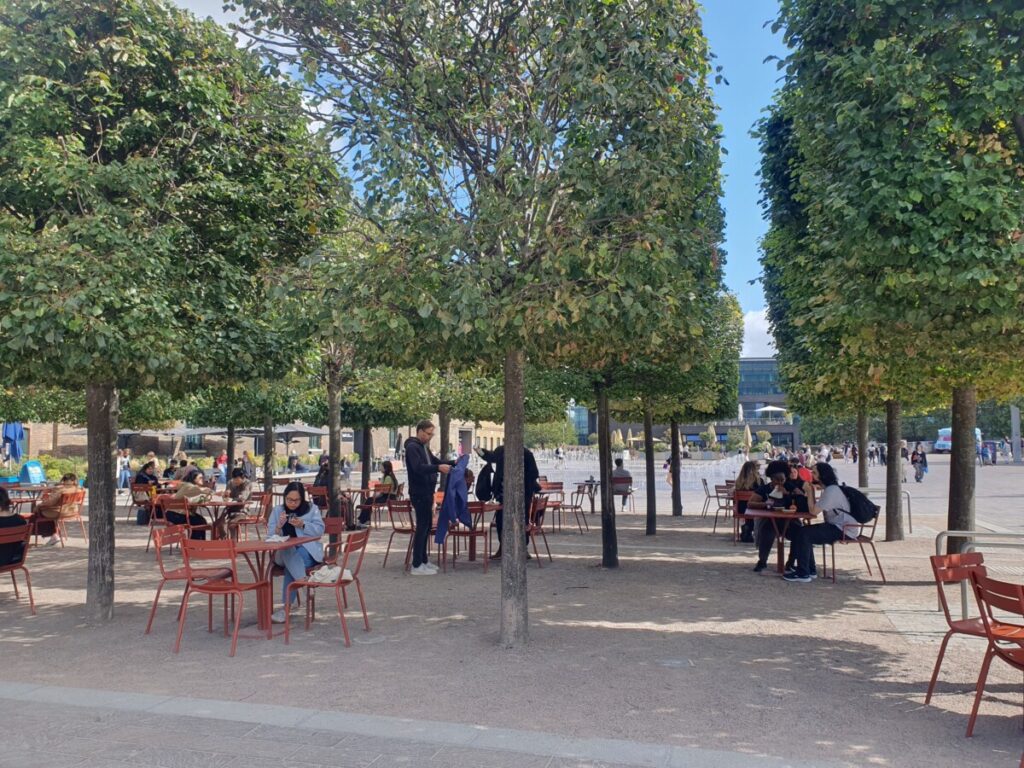
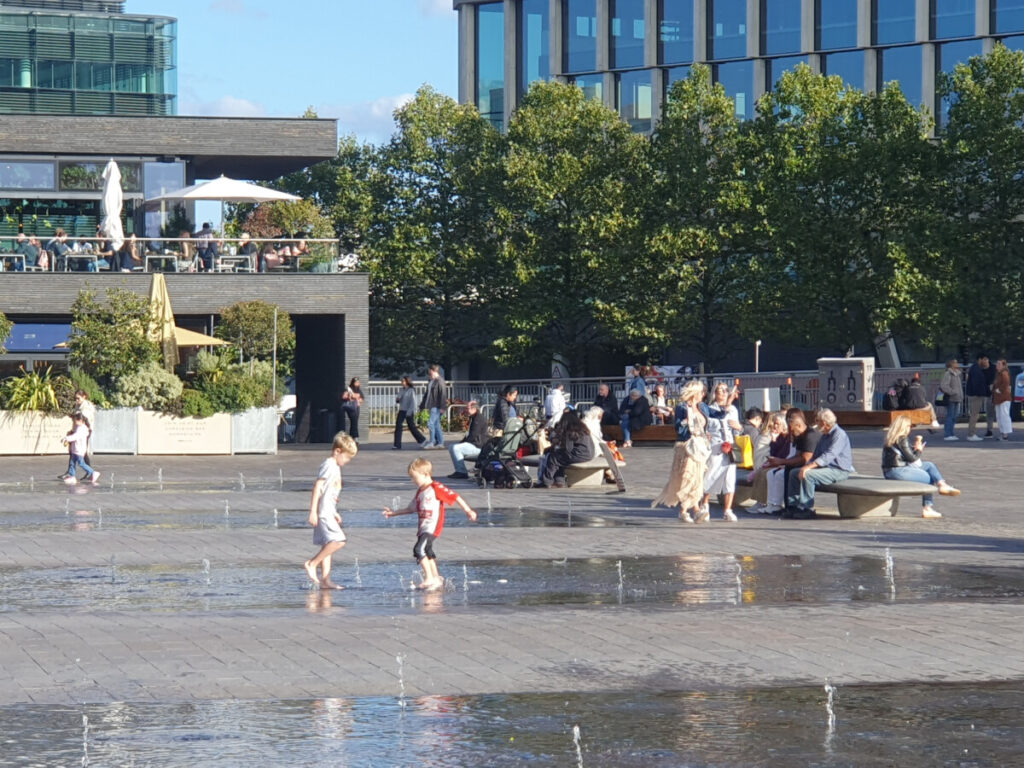
Sophia: That’s an interesting thing for me, that the public space has been designed to encourage people to sit and linger, watch other people and to enjoy seeing children of all ages play in the fountains. So often play spaces are fenced off and many even have signs with age restrictions. Here there’s a sense that people of different ages can all hang out, and play, together.
Sally: That also creates a presence and safety.
Sophia: The public space has been designed to be used and occupied by lots of people, hasn’t it?
Sally: Yes, and that’s very successful I think. It has been cleverly designed and is very well maintained. And made secure. There are security people on site all the time, patrolling the area. They all know me and say hello. I also now know a lot of the people who look after the landscaping, and they are constantly working to keep the planting looking good. There are also plenty of cleaners keeping it looking very tidy.
As a former theatre producer, I see this site a bit like theatre. It is very curated.
Sophia: It does seem like the larger public spaces, and much of the cultural offer, seem to have been designed as a destination, aimed at those visiting, but I know that living here, you also really enjoy a lot of the smaller pocket parks and spaces that are less used by visitors.

Sally: Yes that’s true, visitors don’t use those smaller spaces in the same way as those of us who live here do. And of course at different times of the day, you’ll see different people using the larger green.
Sophia: It’s my impression that the public realm is really working for you here, in terms of seeing and mixing with lots of people. Would you say the same is true of the indoor spaces and amenities?
Sally: When I think about it, apart from the supermarket, there are not many places I would necessarily pop into on my own. They feel like places to go to with people rather than meeting and connecting with people once there.
Sophia: I was thinking about when you and I went to the degree show at Central Saint Martin’s together, and how much you enjoyed that. If you had more opportunities to go and look at student work, do you think you would do that more?


Sally: Yes, yes I would.
It would be interesting to have a bit more of a shop front or regular gallery space at the university where you could go and look at student work throughout the year, and perhaps have a cup of coffee and a chat with them. I feel like the students would like the opportunity to meet with people and show their work. I think they would really appreciate more opportunities to talk to people of different ages.
I’d also like to see more indoor spaces for arts and culture. The Light Room seems to be well used and appreciated, but it is a particular kind of exhibition space. They do set up performances in the outdoor space but I think more indoor performance space would do well here. You’ve already got a great captive audience on site with those living, working and studying here as well as the people who visit from outside. I think that would do really well here. I know there is a stage at CSM, but I don’t know anything about what happens there.
As someone who worked in the arts, education and culture in different countries, I know how important that can be for bringing people of different ages and backgrounds together.
Sophia: So if you were giving your recommendations to developers about how to create multigenerational places that work for people, what would you say?
Sally: I think that in general, not just here in Kings Cross, we need more informal social places where you could drop in on your own, and be with other people. The good old fashioned community centre. But there is also something about how spaces and areas could be better curated. And I don’t mean just by development corporations. It would be more interesting if the different organisations located within that place worked together more to make interesting things happen. Perhaps here at KIngs Cross, better use could be made of some of the still empty ground floor, pavement level spaces on site. What if Google and/or one one of the other big tech companies (eg. Meta, Sony, Samsung), Central Saint Martins and the local primary school all got together and talked about what they could do for and with local people of all ages?
About the Author

Sally de Sousa describes herself as a war baby, born 9 months after her father was rescued from Dunkirk. She spent most of her professional life working in arts and education, enabling international exchange for programmes like the Marshall Scholars and eventually producing and touring performing arts festivals and international theatre productions. She says her best production is her family.